Showing posts with label point source projector. Show all posts

Friday, October 12, 2012

Turn table animation machine

I built this animation machine in collaboration with Jisho Roche Adachi  for  an Exploratorium event focused on time. Jisho an Illustrator / Painter and an old friend who happens to share an interest in animation machines. You can see more of Jisho's work here .  Though originally we wanted to explore using a prism shutter similar to high speed cameras, we tried using a rotating cube and later hexagonal prism which I milled out of an acrylic rod.


Shutters were supposed to spin with a wheel on the turntable (as seen in Jisho's notebook below). These prism wheels proved very hard to synch up and were abandoned after the first few days. 


 The physical design of this project ended up drawing directly from the Electrotachyscopes which I built as a student at Oberlin and the later point source projector project . The machine uses an improved electrotchyscope strobe circuit and laser etched mirror disks based off the the point source projector's slides.


The Electrotachyscopes used an optical gate trigger for the strobe which was less than reliable. For this machine I used neodymium magnets in pockets in the record platen and a reed switch in the tone arm.  This design really stays true to the record player's original form and function. The reed switch in the tone arm reads the magnets and tells the strobe to fire only when its placed over the side of the platen.  We started out with a simple ring of 12 magnets around the edge of platen. However, as this was an automatic turntable we were able to take advantage of the 7'' and 12 '' settings to play different strobe rate "tracks" in the platen. In the photo above there is an inner track of 12 flashes per rotation and an outer of 18 flashes per rotation. Due to the position of the strobe circuit, we ended up shortening the tone arm,  but if we had been able to leave it full length we may have been able to use the 10'' setting for  a third strobe track.       
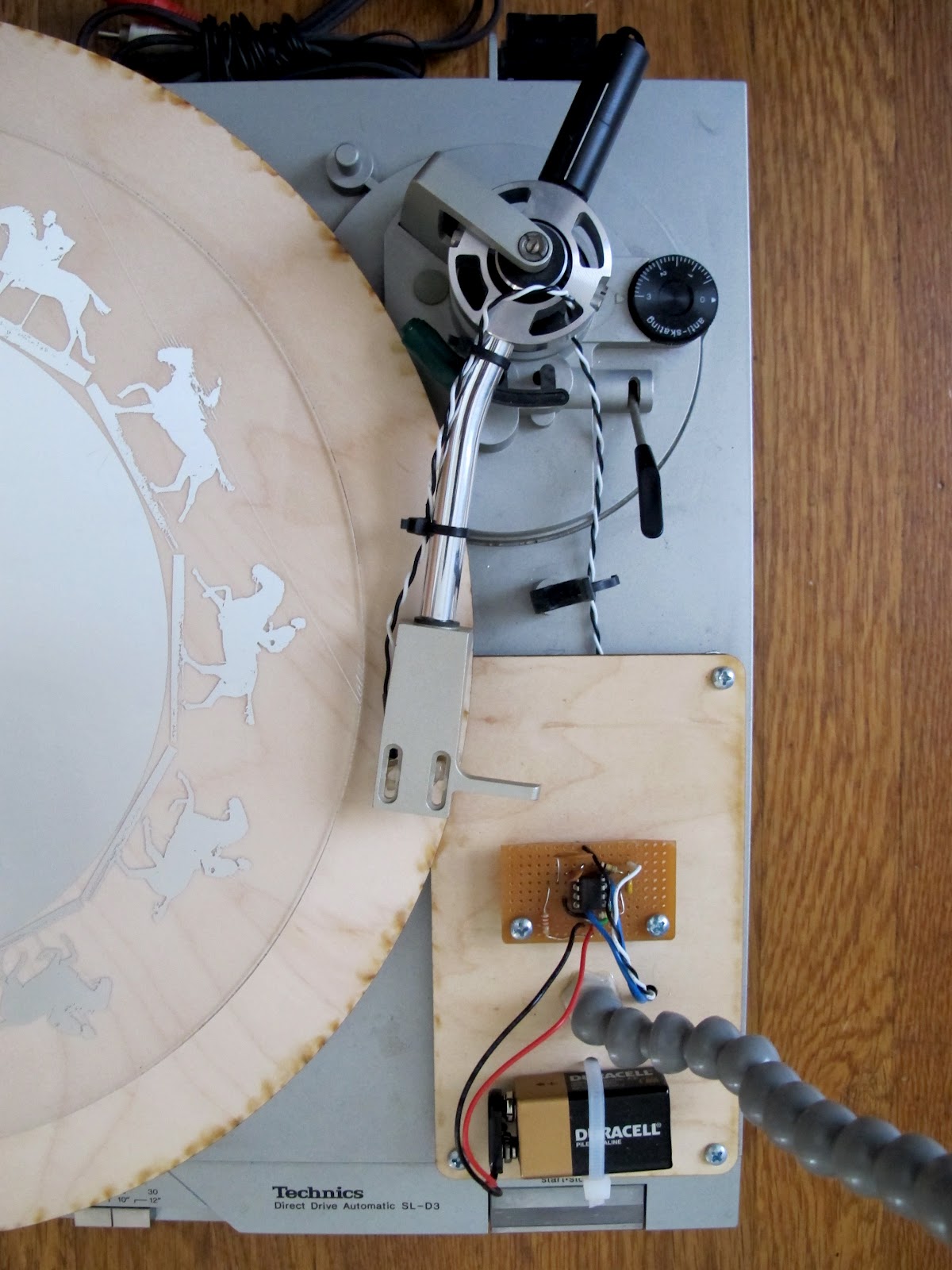
Here is a detail of the strobe circuit with the adjustable Locline light arm and trigger wires running to the magnetic reed switch in the tone arm.  


Here is the machine playing a 12 frame Muybridge animation sequence as seen on the machine's movable velum screen.


Projection detail.


In another adaptation we added a spool to the top of the platen allowing it to play a loop of acetate Jisho had drawn based on video of people walking around the Exploratorium. We discover that this format could either be used to animate the film itself by shining the light through the screen behind it or as a simple shadow projector by placing the moving film between the led light arm and the screen.  


Wednesday, March 21, 2012

Point Source Projector


In my continuing quest for a brighter cheaper simpler projector for the graffiti projector concept, I realized that going lensless is the only way to really achieve this.  Lenses are in my experience cheap when they don't meet your specifications and expensive when they do. On top of that you have to build a precise structure to keep them aligned and usually need more than one for good image quality. I first encountered the idea of a point source projector when I read about Jim Sanborn's Cyrillic Projector you can read more about it here (the pieces A Comma and Lux use a similar technique).


The most basic way to achieve this is to get a very small bright light source and shine it through a cut out. This works well and gives the theoretically maximum brightness at the cost of having no control over throw length.  The closer the projection surface to the projector the brighter and smaller the image. You can't get a bright image very far away as the brightness is governed by the inverse square law. While this is not a great characteristic it is tolerable for the short throw applications I had in mind. The real problem with cutouts is the typical stenciling problem of islands created when you have concentric rings of positive and negative space as seen above.


You can solve this by using a grid of separate half tone dots or using a simplified image with bridges as in a typical stencil, like the A above.  I didn't want to do that much post processing of images, so instead I look to another familiar print making technique screen printing.  Screen printing avoids the problems of islands by suspending the masked zones in the permeable matrix of the screen.  After thinking about this for a bit I wondered if it might be possible to make a plexiglass mirror selectively reflective, by removing the reflective backing in places and relaying on the acrylic to act as the matrix.  Sounds simple but I wasn't at all sure it would work.  I could print some resist on the back and sand blast it, or laser etch it and risk warping and melting.  In the end I went for laser etching, what I found was that as long as the image was not to detailed the mirror would not warp or melt significantly.


Here was the first attempt (I believe it was a picture of Hamilton) turned to be too much detail and the mirror backing oxidized and the acrylic warped.


Here was second one I tried it didn't warp but the mirror back didn't get completely clean in the negative space either.


To use the projector you just have to shine your point source at the etched mirror at a shallow angle.
I used loc-line coolant hose to allow easy adjustment of the light sources position, and made a simple wooden platform to hold the mirror slide and the led driver.  The led I used was the brightest and smallest one I could find, a Cree xp-g lamp it has a 3mm emitter and driven at .75 to 1A can throw a clearly visible 5' image from about 10' in dim light.


Here's a detail of the led and its aluminum heat sink cube.


Here is a detail of the mirror slide projection. It achieves finer detail than a cutout, but still has its defects, you can see patches of oxidation at the bottom of the letters and in general the image can't achieve the crispness of a stencil projection. What is Dec, unremarkably I needed some short words and happened to be making it last December so decided to use Dec in the most decorative gothic font I could find.